Japanese Stiltgrass
(Microstegium vimineum)
Family: Grass family (Poaceae)
Native Range: East Asia
Overview: Shade tolerant annual grass.
Size: 3 feet tall but the arching stems make it appear shorter.
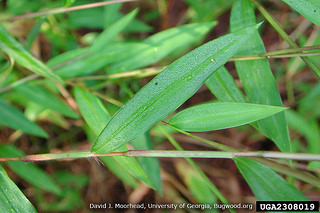
Leaves: 3 inch lance-shaped leaves are limy-green and taper at both ends. The upper surface has a silvery, translucent stripe along the midrib.
Stem/Bark: Stems are stiff. Green then by mid-fall, the stems turn purplish. Sheath has hairy margin and the collar region is hairy, but otherwise lacks hair.
Flowers: In late summer, flowers in branched spike, with 1-3 (rarely 6) branches and there are inconspicuous flowers produced within leaf sheaths.
Seed/Fruit: In early fall, flowers develop into small fruits about 0.1 inch long.
Roots: The name “stiltgrass” comes from the weak, prop-like roots which pull easily out of the ground.
Reproduction:
- Seeds stick to animal fur, clothing, boots, tires, and other surfaces.
- Wind and water currents can carry seeds.
- During the growing season, sprawling stems root at the nodes, sending up new shoots.
Ecological Threat:
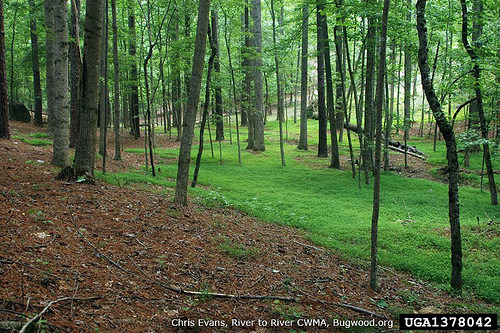
- Forms dense mat crowding out native vegetation.
- Dead plants leave tan-colored, straw-like mulch in forest floor, which persists through winter into spring and early summer.
- No value as a forage plant for wildlife.
Distribution and Background
Native to East Asia. First reported in Massachusetts in 1998. Widely distributed throughout eastern United Stats from northern Georgia to New England.
Habitat Type
Japanese stiltgrass invades moist woodlands, floodplains and stream corridors, wetland margins, fields, thickets, ditches, and utility corridors. Infestations typically begin in disturbed sites.
Management Options
The goal is to prevent the current population from going to seed. This can be achieved by hand pulling, weed whacking/mowing, or foliar herbicide application prior to the plants setting seed (late summer). Plants typically emerge early summer, aim to pull around July and monitor monthly to determine if you need to pull again. Continue this for several years until the seed bank is depleted.
Biological Control
- None currently available.
Manual Control
- Hand pull
Mechanical Control
- Cut prior to going to seed
Chemical Control
- Pre-emergent herbicides will prevent the seeds from germinating
- Post-emergent herbicides applied in summer to prevent setting seed
Notice: Mention of Pesticide Products On This Web Site Does Not Constitute Endorsement Of Any Material. See Control and Disposal Methods for descriptions of application types and warnings.
Disposal
- Create invasive compost pile and allow plants to desiccate
Look-alikes
White cut grass (Leersia virginica) is a native grass with a deeper green color; lacks the silver stripe on the upper midrib of the leaves; and has a tougher root system with small nodules on root filaments (Japanese stiltgrass lacks these nodules).
Basketgrass (Arthraxon hispidus) is invasive in MA and grows in similar habitats throughout most of the mid-Atlantic and Northeast. Basketgrass leaves clasp the stem and have hairy leaf sheaths whereas stiltgrass leaves taper at the base and sheaths are hairless