Autumn Olive
(Elaeagnus umbellata)
Family: Oleaster Family (Elaeagnaceae)
Native Range: East Asia
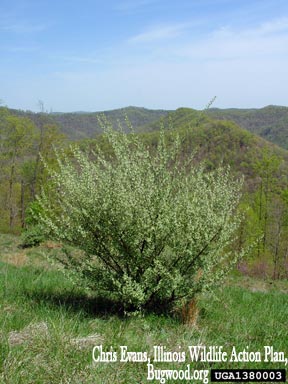
Overview: Deciduous multistem shrub. The stems, buds and leaves have a dense covering of silvery to rusty scales.
Size: Up to 20 feet tall and 30 feet wide.
Leaves: Alternate, egg or lance-shaped, smooth margined, dull green or green/grey above and silvery underneath.
Stem/Bark: Young twigs are silvery with brownish scales (speckle appearance). Thorns may be several inches long. With age bark turns to light gray/gray-brown.
Flowers: Flowers in June/July. The densely clustered blossoms are aromatic, pale yellow, and fused at the base with 4 petals pointed at the tips.
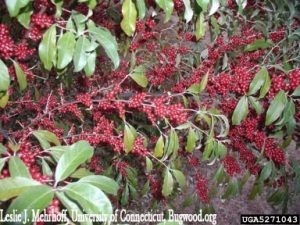
Seed/Fruit: Small, red-brown to pink fruit dotted with brown or silvery scales is produced in August through October.
Roots: Fix nitrogen, allowing them to thrive in nutrient poor habitats.
Reproduction: Seeds, primarily by birds.
Ecological Threat
- Out-competes and displaces native plant species, creating dense shade and interfering with natural plant succession and nutrient cycling.
- Fixing nitrogen in the soil changes which species, including other invasives, from expanding in nutrient poor habitats.
Distribution and Background
Autumn olive was introduced into the United States in 1830 and widely planted as an ornamental, for wildlife habitat, as windbreaks and to restore deforested and degraded lands.
Habitat Type
Autumn olive is found from Maine to Virginia and west to Wisconsin in grasslands, fields, open woodlands and other disturbed areas. It is drought, pH extremes and high toxic metal levels tolerant and thrives in a variety of soil and moisture conditions.
Management Options
Due to it’s ability to fix nitrogen and fast growth manual or mechanical controls alone won’t be effective. A combination of manual/mechanical and chemical methods is most effective for established individuals. Smaller individuals can be removed by hand.
Biological Control
- None currently available.
Manual Control
Remove young seedlings by hand before they produce seeds.
Mechanical Control
Cutting is most effective when combined with an application of herbicide to cut surfaces. A weed wrench may be used to uproot small to medium sized shrubs.
Chemical Control
Apply systemic herbicides like glyphosate and triclopyr to control autumn olive. This species responds well to cut and paint, basal bark and foliar applications.
Notice: Mention of Pesticide Products On This Web Site Does Not Constitute Endorsement Of Any Material. See Control and Disposal Methods for descriptions of application types and warnings.
Disposal
Compost on site
Look-alikes
- Russian olive (Elaeagnus angustifolia) leaves are narrow-elongate with silvery scales on both sides and fruit is mealy, yellow or silvery;
- Thorny olive (E. pungens) has leaves that are persistent, egg-shaped with wavy margins, upper surfaces shiny green, lacking scales, and lower surfaces covered with dull white scales and dotted with light brown scales.
Alternative Native Species
Many attractive native shrubs are available that make great substitutes for autumn olive. A few examples include:
- Downy serviceberry (Amelanchier arborea)
- Black chokeberry (Aronia melanocarpa)
- Gray dogwood (Cornus racemosa)
- Redosier dogwood (Cornus sericea)
- Winterberry(Ilex verticillata)
- Arrowwood viburnum (Viburnum dentatum)
Whenever possible, use as alternatives plant species that are native and adapted to the ecological region where you live. They will be more valuable to the wildlife species that have evolved with them and depend upon them for food and shelter. Check with your local native plant society for recommendations and sources of native plants.
More Information
For more information on invasive species in Massachusetts, refer to the Massachusetts Prohibited Plant List at https://www.mass.gov/massachusetts-prohibited-plant-list.